
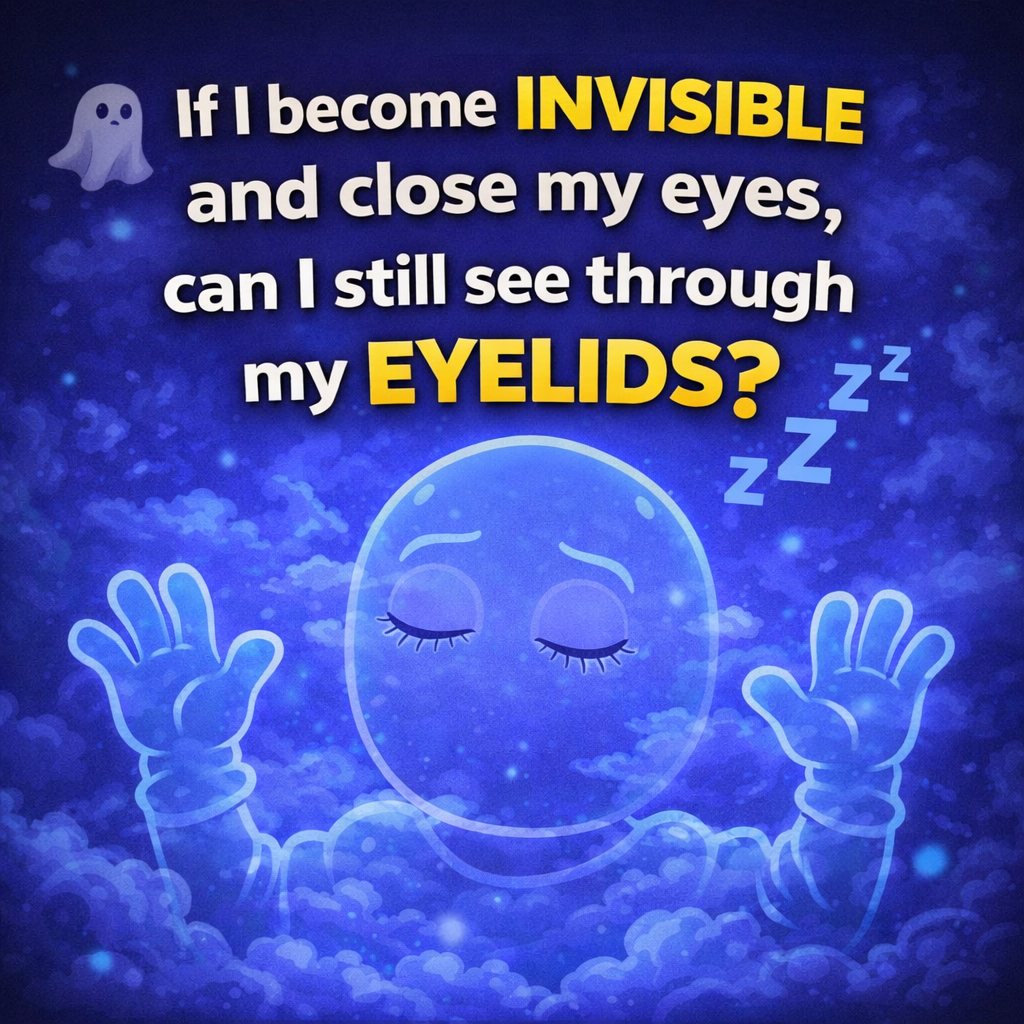
A question that sounds dumb for about three seconds — until you realize the real answer is even wilder than you expected.
⚡ Quick Answer
No — but not for the reason you think. If you were truly invisible, you’d be completely blind whether your eyes are open or closed. Your eyelids being transparent is the least of your problems.
Let’s break down why invisibility is basically a sensory nightmare.
Wait, Why Would I Be Blind?
Here’s the core problem: seeing requires your eyes to absorb light. Your retina works by catching photons and converting them into electrical signals for your brain. That absorption is a physical interaction — and it’s visible.
If your entire body — including your retinas — became truly invisible, that means light passes straight through you without interacting with anything. No absorption. No signal. No vision.
In other words, an invisible person is a person whose eyes can no longer do their one job.
The paradox: To be invisible, light must not interact with you. To see, light must interact with your eyes. You can’t have both. Pick one.
But What About the Eyelids Specifically?
This is the fun part of the question. Right now, your eyelids block light because they’re opaque tissue full of blood vessels. When you close your eyes, you see that reddish-dark nothing.
If you became invisible, your eyelids would be transparent — light would pass right through them. So in theory, closing your eyes wouldn’t “block” anything anymore.
But here’s the twist: it doesn’t matter. Your retinas are also transparent. Light passes through your closed eyelids, then passes through your retinas, then exits out the back of your head. Nothing stops it. Nothing detects it. You see absolutely nothing regardless of whether your eyes are open or shut.
The Full Invisibility Problem, Step by Step
Step 1: Light hits your face. Normally it would bounce off your skin. But you’re invisible, so it passes straight through.
Step 2: Light reaches your eyelids. Normally they’d block it (if closed) or let it through (if open). But invisible eyelids are transparent, so light goes through either way.
Step 3: Light reaches your retinas. Normally the photoreceptor cells would absorb photons and fire neural signals. But invisible retinas can’t absorb anything. The light just… keeps going.
Step 4: Result — Open eyes, closed eyes — doesn’t matter. You’re living in permanent, absolute darkness. Congratulations on your superpower.
Could “Partial Invisibility” Fix This?
Some sci-fi writers have tried to solve this by making only the outside of the body invisible while keeping internal organs functional. In that case, your retinas would still absorb light, and you could see.
But then you’d have a new problem: two floating eyeballs. Your retinas would be visible as dark spots hovering in mid-air, because they’d be the only parts of you still interacting with light. Not exactly stealthy.
H.G. Wells actually acknowledged this in The Invisible Man (1897) — the character’s eyes are faintly visible because the retinas must remain opaque to function.
So What’s the Real Answer?
The question assumes that invisibility only affects the outside — as if your eyelids become transparent windows while everything behind them works normally. That’s a fun idea, but physics doesn’t offer a clean boundary between “outside” and “inside” your body.
True invisibility = total transparency = total blindness. Your eyelids being invisible is a neat detail, but it’s a footnote in a much bigger problem: your entire visual system is broken.
👁️🗨️ The Dummy Verdict
Closing or opening your eyes wouldn't matter — because you can't see at all. Invisibility is really just blindness with better marketing.
© 2026 dummyquestions.com — Big answers to questions nobody asked.




Add comment