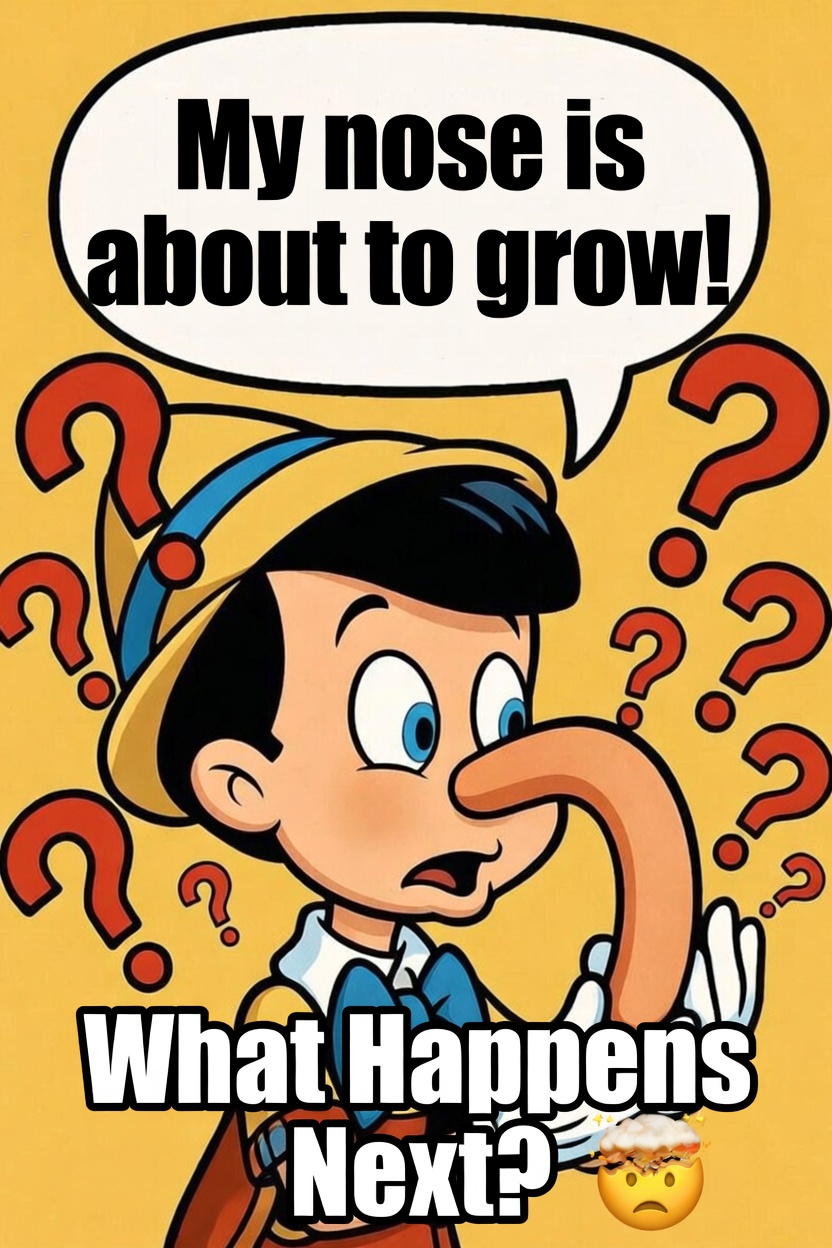
“If Pinocchio says ‘My nose is about to grow,’ is he lying — or telling the truth? And what does his nose actually do?”
It looks like a silly children’s riddle. But the moment you pull at this thread, you fall into one of the most delightful rabbit holes in all of logic: a self-referential paradox that has genuinely puzzled philosophers, computer scientists, and linguists. Welcome back to DummyQuestions, where we take the dumbest questions and chase them all the way down.
Let’s break this apart properly — because the answer is not as simple as “his nose grows” or “it doesn’t.” It depends entirely on what Pinocchio means, when he says it, and which version of the rules we’re playing by.
First, let’s understand the rules
In the original 1883 novel The Adventures of Pinocchio by Carlo Collodi, Pinocchio’s nose grows when he tells a deliberate lie — a conscious, intentional falsehood. This is the key: the nose responds to intent to deceive, not merely to saying something that turns out to be untrue.
This distinction matters enormously. If Pinocchio genuinely believes something false, and says it, his nose stays put. He’s not lying — he’s just wrong. The magical nose is a lie detector, not a truth detector. It measures moral intent, not factual accuracy.
The rule, precisely stated
Pinocchio's nose grows if and only if he consciously intends to deceive the listener. A sincere but mistaken statement does not trigger growth. A deliberate falsehood always does.
Now, the paradox: “My nose is about to grow”
Here’s where it gets beautiful. Pinocchio says:
"My nose is about to grow."

Is this a lie? Is it true? Can it be both? Can it be neither?
Let's think through every possible outcome.
There are only two ways this statement can land: it’s either true (the nose does grow) or false (the nose doesn’t grow). Let’s follow both paths.
Path A: Suppose the statement is a lie
If “my nose is about to grow” is a lie, then the nose should grow — because lies trigger growth. But if the nose grows, the statement turns out to be true. Which means it wasn’t a lie. Contradiction.
Path B: Suppose the statement is true
If “my nose is about to grow” is true, then the nose grows. But for the nose to grow, Pinocchio must have lied. If he told the truth, the nose shouldn’t grow. Which means the statement was false. Contradiction.
| Assumption | What the nose does | Result | Status |
|---|---|---|---|
| Statement is a lie | Nose grows (lies trigger growth) | Statement becomes true | Contradiction |
| Statement is true | Nose stays same (no lie, no growth) | Statement becomes false | Contradiction |
| Nose grows and doesn’t grow | Both simultaneously | Physical impossibility | Paradox |
We’re caught in a loop. No consistent outcome exists. This is a genuine logical paradox — not just a brain teaser, but a real breakdown in the rules of the system.
This is the Liar’s Paradox in disguise
Philosophers have been wrestling with this exact structure since Ancient Greece. The classic version, attributed to Epimenides of Crete, goes: “This statement is false.” If it’s true, it’s false. If it’s false, it’s true. Around and around forever.
The formal version — known as the Liar’s Paradox — was later formalized by logicians like Bertrand Russell and Alfred Tarski in the 20th century. Tarski’s solution was to argue that no language can coherently make true statements about its own truth values. In other words: some sentences are simply outside the scope of the rules they’re trying to invoke.
Pinocchio’s statement is doing exactly this. It’s a sentence that tries to predict the outcome of its own evaluation — and that self-reference is what causes the system to crash.
But wait — there are other scenarios
Not all versions of this question are paradoxical. It depends entirely on what Pinocchio knows and intends when he says it.
😐 He says it randomly
With no intent to deceive, the nose doesn’t grow — and the statement turns out false. No paradox, just a wrong prediction.
😏 He says it to trick someone
If he intends to mislead — believing the nose won’t grow — that’s a lie. The nose grows. The statement becomes true. A self-fulfilling deception.
🤔 He genuinely doesn’t know
If he’s uncertain and states it sincerely, the nose’s behavior depends on whether it was true or false — but no logical loop forms, because there’s no deceptive intent.
🌀 He intends the paradox
If he knows exactly what he’s doing and says it to create a contradiction — the system has no valid output. The universe (or the author) must pick a resolution.
What would actually happen? Three theories
Since logic alone can’t resolve the paradox, philosophers and writers have proposed three broad escape routes:
Theory 1 — The nose oscillates. It starts to grow, making the statement true, so it stops growing, making it false, so it starts again. An infinite, rapid oscillation. Pinocchio’s nose vibrates like a plucked string, forever.
Theory 2 — The system crashes. Just like a computer hitting an undecidable instruction, Pinocchio freezes. His nose neither grows nor stays still. He simply stops. A living blue screen of death, carved from wood.
Theory 3 — The magic breaks. The enchantment that governs his nose was designed for simple truths and lies. It wasn’t built to handle self-reference. Faced with an impossible instruction, the spell simply fails. The nose does nothing, the magic rule is suspended, and Pinocchio walks away unscathed — and slightly smug.
There is no clean answer — and that's the point. Pinocchio's nose paradox is a playful version of the Liar's Paradox, a problem that broke 20th-century logic and forced mathematicians to completely rethink the foundations of formal reasoning. The dumbest bedtime question turns out to be the same one that haunted Bertrand Russell for years. As always: the silliest questions go the deepest.



Add comment