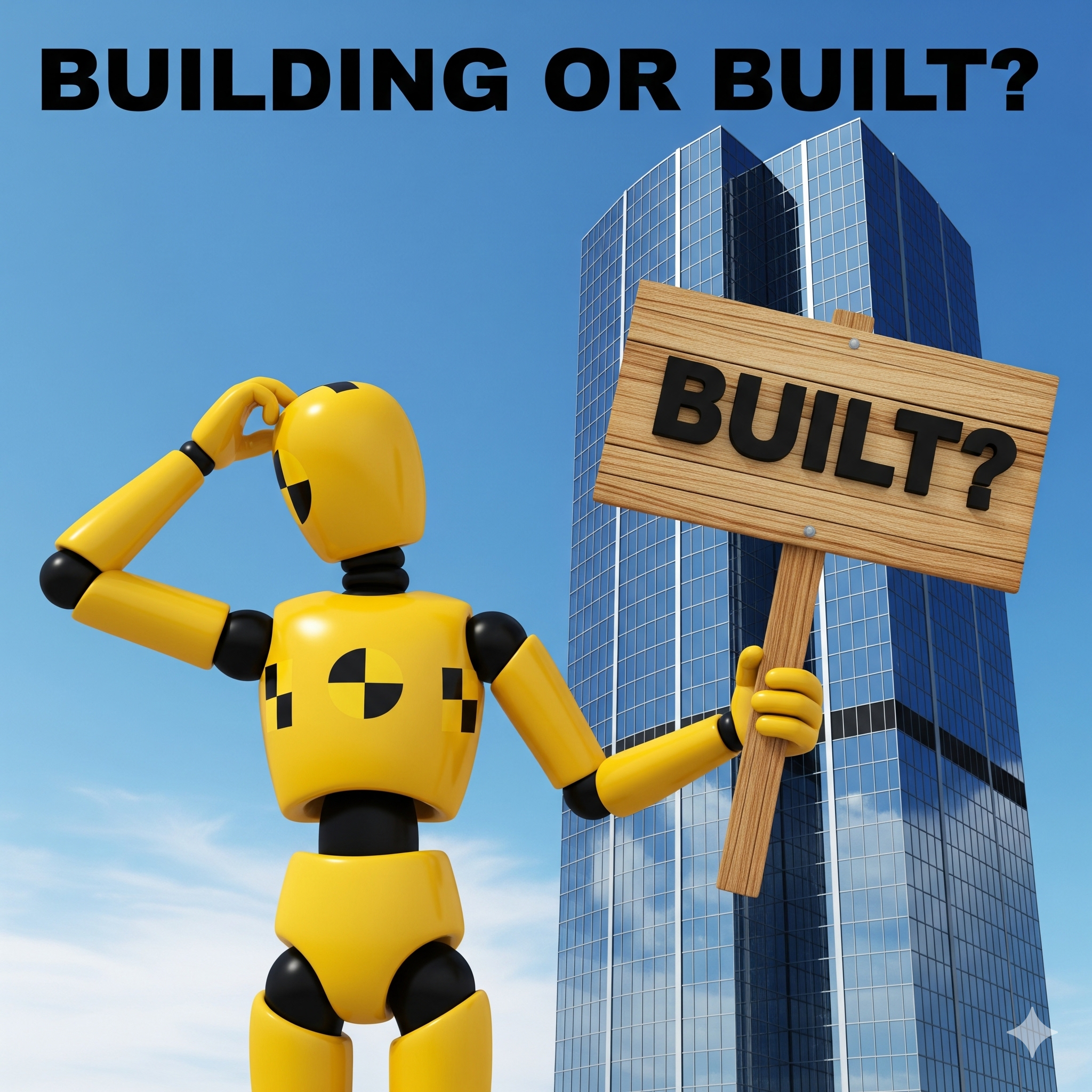
“If a building is already built, why do we still call it a ‘building’ and not a ‘built’?”
It’s the kind of question that sneaks up on you in the shower at 2am. One second you’re minding your own business, and the next — you’re staring at an office tower wondering why the English language decided to name a completed structure after an ongoing process. Welcome to DummyQuestions, where no thought is too ridiculous to investigate.
Spoiler: the answer is genuinely fascinating. And it has everything to do with how English evolved — often messily, always chaotically — over more than a thousand years.
First, Let’s Be Clear: This Is a Legitimately Weird Word
In English, we have a habit of turning verbs into nouns using the suffix -ing. “Running” can be the act of running or a thing you do. “Painting” can mean the act of applying paint, or the finished artwork hanging on your wall. So “building” should just mean the act of constructing — right?
Well, yes. And also: the completed thing that results from it. Which is where the absurdity begins.
Quick Definition
A gerund is an -ing word that functions as a noun. "Building" started as a gerund — "the act of building" — and eventually came to mean the permanent structure itself. English just... let that happen.
The Etymology: A Trip Back to Old English
The word “building” traces its roots to the Old English verb byldan, which meant “to construct” or “to erect.” This came from the Proto-Germanic root *buld-, which itself is related to words meaning “to dwell” or “to live.” (Fun fact: the word “bold,” as in “a bold house,” is a distant linguistic cousin.)
By the Middle English period (roughly 1100–1500 AD), English speakers had started using “building” not just to describe the action, but also to refer to the physical result of that action. This is a totally normal linguistic process called metonymy — where a word that describes an activity starts being used to describe the product of that activity.
| Word | Original meaning | Also means… |
|---|---|---|
| Building | The act of constructing | A completed structure |
| Painting | The act of applying paint | A finished artwork |
| Flooring | The act of laying a floor | The floor material itself |
| Covering | The act of covering | The thing that covers |
| Clothing | The act of dressing | Garments and apparel |
So “building” is in excellent company. English is full of -ing words that have pulled double duty for centuries, referring to both a process and the product of that process. It’s not a bug — it’s a feature. A very confusing, linguistically chaotic feature.
But Wait — Shouldn’t It Be Called a “Built”?
"If it's already built, why isn't it called a 'built'?"
Because English names things after what they represent, not what tense they're in. A "building" is a monument to the act of building — it carries the memory of how it came to be. Language is poetic like that. Or just lazy. Probably both.
The honest answer is: there’s no deep logical reason. “Built” as a noun never caught on, and “building” did. Language isn’t a formal system of rules — it’s the fossilized record of what millions of people decided to say over hundreds of years. Conventions win, not logic.
In fact, in many languages, the word for a building is derived from the finished state — not the action. French has bâtiment (from an old word for frame or structure), Spanish has edificio (from Latin aedificium, meaning “a thing built”). English just went its own eccentric way, as it so often does.
The Bigger Picture: English Is Full of These
Once you notice this pattern, you can’t unsee it. The English language is riddled with words that are frozen in the middle of actions that were long since completed:
🔩 Fitting
A “fitting” for pipes or clothes was originally just the act of fitting things together.
🍞 Baking
We call it a “bakery” but never a “bakery item” — bread is the result, not the action.
🧵 Knitting
“Knitting” once only meant the act — now it refers to both the craft and sometimes the knitted item itself.
🪵 Flooring
“Flooring” is the act of installing a floor — and also the material you’re installing.
So What’s the Actual Takeaway?
Language evolves through use, not through careful committee decisions. Words accumulate meanings the way buildings accumulate floors — layer by layer, over time, with no single architect responsible for the whole design. “Building” got stuck with both the action and the result, and nobody bothered to file a formal complaint.
It’s a reminder that asking “why does this word mean this?” is almost always more interesting than it first appears. Behind every strange quirk of English there’s a miniature history lesson: of invasion, migration, trade routes, printing presses, and millions of ordinary people just trying to make themselves understood.
Calling it a "building" makes perfect sense — etymologically. The -ing suffix is functioning as a gerund turned noun, naming the result after the process. It's a pattern so common in English that we stopped noticing it centuries ago. But the real dummy move? Never asking the question in the first place.




Add comment