(Spoiler: Your brain is the problem.)
You know that feeling when a TV show cuts to black right before the good part?
Your heart rate spikes. You mutter something unprintable. You sit there for a full thirty seconds just staring at the credits like they personally wronged you.
That’s not a character flaw. That’s your nervous system doing exactly what it was built to do.
Welcome to the Zeigarnik Effect — arguably one of the most exploited psychological phenomena in modern entertainment, social media, and yes, your coworker who always starts a story with “okay so I probably shouldn’t tell you this, but—” and then gets interrupted by a phone call.
Table of contents
So What Actually Is the Zeigarnik Effect?
In the 1920s, a Soviet psychologist named Bluma Zeigarnik noticed something odd while watching waiters at a café in Vienna.
The waiters could remember every detail of open, unpaid orders — items, modifications, who asked for extra sauce. But the moment the bill was settled? Gone. Completely wiped. They couldn’t recall the order at all.
Zeigarnik thought this was worth investigating, so she ran a series of experiments. Participants were given tasks — puzzles, math problems, small crafts — but were interrupted mid-task on some of them while allowed to finish others.
The result: people remembered the interrupted tasks nearly twice as well as the completed ones.
Not because the interrupted tasks were harder. Not because they were more interesting. Simply because they were unfinished.
Why Does Your Brain Do This to You?
Here’s where it gets neurologically uncomfortable.
Your brain doesn’t like open loops. When you start a task, your brain essentially opens a file and keeps it active in working memory — a kind of low-level background process running constantly until the task is resolved.
Think of it like a tab in your browser that you never close. It just sits there, quietly eating RAM.
This is useful in the wild. If you’re a prehistoric human who starts building a shelter and gets distracted by a predator, you need your brain to keep reminding you: hey, the shelter isn’t done. Hey. HEY. The shelter.
The problem is that your modern brain cannot tell the difference between “unfinished shelter that will affect your survival” and “Netflix episode that ended on a cliffhanger.”
Both get the same treatment: intrusive, involuntary, annoyingly persistent cognitive activation.
The Three Everyday Villains Using This Against You
1. Television writers
Modern showrunners didn’t discover the Zeigarnik Effect by accident. The entire architecture of prestige TV is built on manufacturing unresolved tension. Every episode ends mid-scene, mid-revelation, or mid-fight — not because the writers ran out of time, but because an unresolved loop compels you to return.
“Just one more episode” isn’t a lack of willpower. It’s your brain refusing to close a file.
2. Gossip
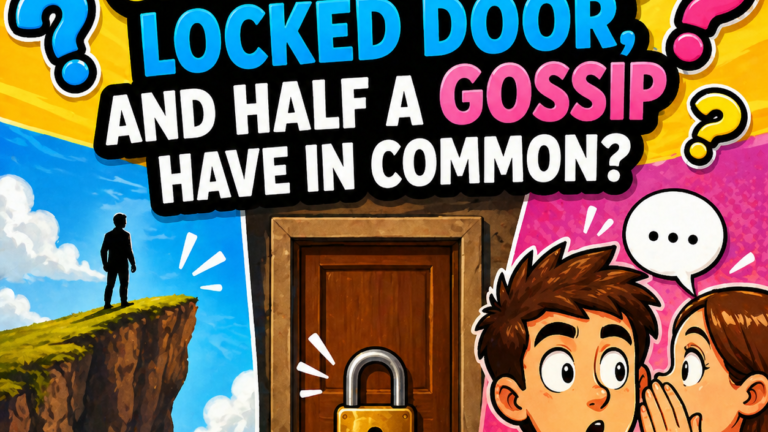
There’s a reason half-told gossip is more maddening than the complete version. Once you hear “okay so apparently Sarah and the CFO—” and then nothing, your brain has already opened the file. It will now check that file repeatedly, without your permission, for days.
The information doesn’t even need to be true. The loop just needs to exist.
3. Locked doors, unanswered texts, and loading screens
A door that’s clearly locked and labeled “Staff Only” is genuinely more interesting than an open door showing a broom closet. The inaccessibility alone creates an open loop. Your brain assigns importance to the unknown based purely on the fact that it’s unresolved — not on any actual evidence of value.
The Manipulation Is Real (And It’s Everywhere)
Once you understand the Zeigarnik Effect, you start seeing it in places you can’t unsee.
Email subject lines that end with “…you won’t believe what happened.” Push notifications designed to give you half the information so you have to open the app. YouTube thumbnails with expressions of shock pointing at something outside the frame. TikTok videos that cut off exactly three seconds before the payoff and continue in “Part 2.”
All of it is the same trick: create an open loop, and the brain will work to close it.
The attention economy didn’t build this vulnerability. They just found it and moved in.
Can You Fight It?
Kind of. Awareness helps — but not as much as you’d hope.
Knowing that a cliffhanger is a manufactured psychological trap doesn’t stop the trap from working. Your brain’s loop-closing drive is largely involuntary. You can’t logic your way out of it in real time.
What you can do:
Write things down. Research by Masicampo and Baumeister found that simply writing a plan for an unfinished task significantly reduced intrusive thoughts about it. The brain didn’t need the task to be done — it just needed evidence that the loop would eventually close.
Recognize the manipulation. When you feel urgency about an unresolved piece of content, pause for one second and ask: is this loop important, or is it manufactured? You won’t always be able to resist, but occasionally catching it in the act gives you a choice.
Finish things. Obviously. But the research suggests that even partial completion — breaking a big task into a small first step and completing that — is enough to reduce the cognitive load.
The Uncomfortable Punchline
Here’s the part that should make you feel seen and slightly violated at the same time:
You didn’t click on this article because you were calmly interested in cognitive psychology.
You clicked because the title left something unresolved. A cliffhanger. A locked door. A half-told story. Your brain opened a loop the moment you read the question — and then it made sure you’d come back to close it.
The Zeigarnik Effect didn’t just explain your behavior today.
It caused it.
So — now that the loop is closed — how does it feel?
(Be honest. You’re already thinking about what else is unfinished.)

Add comment