
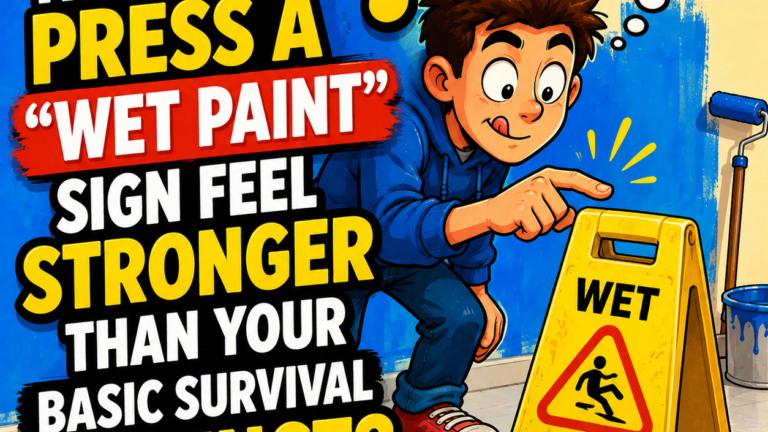
A Tale of Two Fingers
You’re walking down the street. Minding your business. Living your life.
Then you see it.
A wooden bench. A bright red sign. Three little words that are about to ruin your day:
“WET PAINT.”
Your logical brain — the one that pays taxes and remembers your mom’s birthday — says, “Cool. Noted. Moving on.”
Your index finger, however, has other plans.
It’s already extending. Slowly. Like the world’s dumbest periscope. Drawn toward the freshly glossed wood like a moth to a very stupid flame.
And then — contact.
A tiny, tactile betrayal. Your finger comes back red. The sign was telling the truth. The sign is always telling the truth.
So why did you do it?
Why does the same survival instinct that kept your ancestors from petting saber-toothed tigers completely short-circuit the moment it encounters a freshly painted fence?
The answer isn’t that you’re stupid. (Well. Not just that.) It’s a beautiful cocktail of psychological reactance, tactile empiricism, and the deeply human urge to be a rebel without a cause — or even a clue.
Let’s break down why your brain treats a warning sign like a personal invitation.
1. The Forbidden Fruit Effect: When “Don’t” Means “Please Do”
Psychologists have a fancy name for this: Psychological Reactance Theory, coined by Jack Brehm in 1966.
Here’s the gist:
The moment someone tells you that you can’t do something, your brain detects a threat — not to your safety, but to your freedom. And freedom, as anyone who’s ever been on a road trip with their parents knows, is sacred.
So your brain does something weirdly heroic and stupid at the same time:
It manufactures a sudden, urgent desire to do the forbidden thing — just to prove it still can.
You don’t actually want to touch wet paint. You want to know that you could. The touching is just the receipt.
The sign isn’t a warning. It’s a dare written by a stranger.
This is the same reason kids eat the cookie they were told not to. The same reason “Do Not Press This Button” buttons get pressed within 0.4 seconds. The same reason your friend who “quit social media” is somehow still posting about it.
Reactance is your inner teenager, and it never actually moved out of the house.
2. L’Appel du Vide: The Hardware Store Edition
The French — because of course it was the French — have a phrase for this: L’appel du vide, or “The Call of the Void.”
It’s that bizarre, intrusive urge you get to do something mildly destructive for absolutely no reason. Jumping off a high balcony. Swerving into oncoming traffic. Yelling “BOMB” on an airplane. (Please don’t.)
Most of the time, you ignore these thoughts because the survival cost is, you know, death.
But wet paint? Wet paint is the clearance bin of L’appel du vide.
The cost of giving in is laughably low:
- A stained index finger
- A vaguely embarrassed walk home
- The lingering knowledge that the sign was right and you were wrong
That’s it. No tigers. No cliffs. No funeral.
So your brain, ever the curious little goblin, decides this is a safe environment to test the void’s call. It’s basically a low-stakes science experiment where the only thing at risk is your dignity.
And let’s be honest — your dignity has survived worse.
3. Tactile Empiricism: When Your Eyes Lie, Your Fingers Investigate
Here’s where it gets actually interesting.
For roughly 300,000 years, humans survived by touching things. We squeezed fruit to check ripeness. Felt textures to identify safe tools. Pressed surfaces to know if they’d hold our weight. Touch was — and still is — your brain’s most trusted lie detector.
Your eyes can be fooled. Your nose can be fooled. But your fingertips? Those things have receptors so sensitive they can detect a single grain of sand on a smooth surface.
Now consider modern paint.
Modern paint is insane. It’s glossy. It reflects light. Wet paint and dry paint look almost identical to the human eye — like the surface is already a solid, finished mirror.
Your visual system looks at it and says: “Hmm. This appears to be done.”
Your brain, suspicious of its own eyes, deploys the Tactile SWAT Team — your fingers — to verify the truth on the ground.
We didn’t evolve for glossy enamel. We evolved for berries and bark.
We are, essentially, toddlers with credit cards and car keys. We know better. We just don’t trust better. Not until we’ve touched it.
4. The “I Can Fix This” Delusion
Now, this is the truly tragic part of the story. The part where the comedy turns into mild horror.
Because you don’t just touch the paint.
Oh no.
You touch the paint, and then your brain — that same brain that told you it was fine to touch the paint in the first place — immediately launches a recovery operation.
The internal monologue goes something like:
“Okay, that was wetter than I thought. But maybe if I just touch it very, very lightly. At the corner. With one finger. Like a ninja.”
Spoiler alert: You are not a ninja.
You are a person standing in public with a blue finger, trying very hard to look natural while subtly wiping it on the back of your jeans, hoping nobody from your apartment building walked by.
The mark is already there. The sign already won. The bench is undefeated.
This is the “I Can Fix It” Delusion — the universal human belief that we can outsmart the consequences of a decision we made approximately three seconds ago.
We can’t. We never could. The paint always wins.
So Why Do We Keep Doing It?
Here’s the beautiful, slightly unhinged truth:
We touch the wet paint because we are curious, rebellious, and quietly distrustful of authority — even when that authority is a piece of laminated cardboard zip-tied to a bench.
Your survival instincts are working fine. They’re just not in the driver’s seat right now.
Right now, curiosity is driving the bus. Reactance is in the passenger seat. The Call of the Void is in the back rolling down the windows. And your fingertip is the GPS that nobody asked for but everyone listens to.
The next time you see a “WET PAINT” sign and feel that tiny, irrational pull in your hand — congratulations.
You’re not broken. You’re just extremely human.
Now go wash your finger.
Your Turn
Have you ever touched the wet paint and immediately regretted it?
Drop your most colorful (literally) stories in the comments. Bonus points if it ruined an outfit. Double bonus if it was on a first date.
We need to know we’re not alone in this.
Liked this? You’ll probably also enjoy our deep dive into [why we read every single word in elevator emergency instructions but tune out airplane safety briefings] — same brain, different glitch.


Add comment