
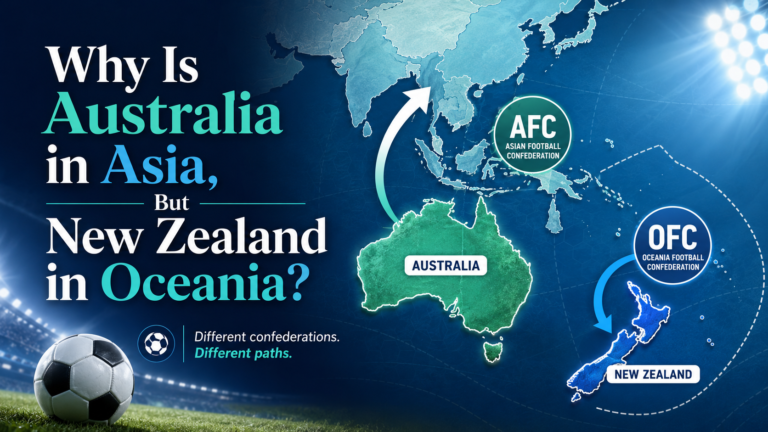
Look at a map. Australia and New Zealand are practically neighbors. Two big chunks of land, floating in the same corner of the planet, sharing the same ocean, the same time zones, the same beef with each other over who invented the pavlova.
So here’s the dumb question that breaks people’s brains:
Why does Australia play World Cup qualifiers in Asia, while New Zealand stays in Oceania?
And the even dumber follow-up:
Does that mean New Zealand now just… strolls into every World Cup unopposed?
Buckle up. The answer is gloriously petty, weirdly strategic, and a perfect example of why football refuses to respect geography.
Geography didn’t decide this. FIFA did.
Here’s the twist that fixes everything:
World Cup qualification has almost nothing to do with where a country actually is. It’s based on FIFA confederations — the six giant regional clubs that organize football around the world.
Australia is physically sitting in Oceania. Nobody disputes this. But in football terms, Australia belongs to the Asian Football Confederation (AFC).
New Zealand? Still loyal to the Oceania Football Confederation (OFC).
So Australia qualifies through Asia. New Zealand qualifies through Oceania. Same neighborhood, completely different leagues. It’s like two roommates rooting for different teams — except one of them changed countries to do it.
The map says they’re together. Football says, “Yeah, no.”
So why did Australia ghost Oceania?
Picture this. For years, Australia was the absolute monster of Oceania. The shark in a kiddie pool. They’d steamroll Fiji, demolish Tahiti, and (famously) beat American Samoa 31–0 in a single game in 2001. That’s not a scoreline. That’s a crime scene.
You’d think dominating your region like that guarantees a World Cup spot.
It did not.
Here was Oceania’s cruel little catch: winning the region didn’t actually send you to the World Cup. It just earned you the right to play a brutal intercontinental playoff against a powerhouse from another continent — usually a battle-hardened South American side.
So Australia could win everything in Oceania, score a thousand goals, lose a single playoff to Uruguay, and watch the World Cup on TV like the rest of us.
That happened. More than once. It was soul-crushing.
The big move: Australia switches teams
In 2006, Australia rage-quit Oceania and joined Asia.
From a football brain perspective, it was genius.
Instead of being a giant in a tiny pond, Australia became a strong-but-not-untouchable team in a much deeper, much tougher ocean. Suddenly the Socceroos were playing real, meaningful matches against Japan, South Korea, Iran, and Saudi Arabia — proper opponents who could actually punch back.
That kind of pressure does something to a national team. It sharpens you. You stop padding your stats against islands with a population smaller than a single Australian suburb, and you start grinding through games that matter.
And the bonus? Asia hands out way more World Cup slots than Oceania ever did. More competition, but also a more honest, less coin-flippy path to the tournament.
Australia didn’t abandon geography. They just decided trophies beat map accuracy.
New Zealand stayed. And then something amazing happened.
New Zealand looked at all of this and said, “We’re good, thanks.”
They stayed in OFC. And the second Australia left, New Zealand inherited the crown. With the big bully gone, the All Whites became the undisputed kings of Oceania — the team everyone else in the region is desperately trying to dethrone.
But for a long time, ruling Oceania still came with that same cursed asterisk Australia hated so much.
New Zealand made the World Cup in 1982 and 2010 — and then lost three straight intercontinental playoffs to miss out on 2014, 2018, and 2022. Dominant at home. Heartbroken on the world stage. They were basically Australia 2.0, stuck in the exact same trap.
So no — being the best in Oceania was not a golden ticket. For years it was more like a coupon that expired before you could use it.
The 2026 plot twist that changed everything
Then FIFA blew up the format.
The 2026 World Cup expanded to 48 teams, the biggest tournament in history. And to fit everyone in, FIFA finally gave Oceania something it had never had before:
A direct, guaranteed World Cup slot.
For the first time ever, the winner of Oceania qualifying goes straight to the World Cup. No playoff. No South American boss battle. No tears. Just a plane ticket.
And here’s where the story stops being theoretical.
New Zealand didn’t just have a chance — they cashed it in. In March 2025, the All Whites beat New Caledonia 3–0 to lock up Oceania’s brand-new direct slot and qualify for the 2026 World Cup. First appearance in 16 years. The trap that haunted them for a decade finally got dismantled — by a rule change.
So the system that once tortured Australia into leaving is now the exact system rewarding New Zealand for staying. Sometimes patience pays. Sometimes the pond becomes a kingdom.
But is it actually a free ticket? Not quite.
Let’s not get carried away. New Zealand still has to play the qualifiers and win them. The slot is direct, but it isn’t automatic.
Oceania isn’t empty. Fiji, Tahiti, New Caledonia, Solomon Islands, Vanuatu, and Papua New Guinea all want that one golden seat. New Zealand is the heavy favorite every cycle — but football has a nasty habit of ignoring favorites.
One red card. One penalty shootout gone wrong. One injury crisis. One freak generation of talent emerging from a tiny island nation. Any of those could flip the script.
Football is not a spreadsheet. The stronger team usually wins. Usually. That word is doing a lot of heavy lifting, and entire nations have had their hearts broken by it.
So, what’s the actual answer?
Let’s tie this absurd little knot:
- Australia plays in Asia because it switched confederations in 2006 for a tougher, fairer path to the World Cup — not because of geography.
- New Zealand plays in Oceania because it simply never left OFC.
- And no, New Zealand doesn’t get a free pass — but under the new 48-team format, it’s the overwhelming favorite to keep qualifying, and it already used that new direct slot to reach 2026.
The map will tell you these two countries belong together. Football will tell you they made completely different choices and got completely different outcomes.
Which is the whole lesson here, really. The map shows you where things are. It rarely shows you why they ended up that way.
Because in football, the map is never quite the territory.
Your turn: Was Australia a genius for leaving, or did they just dodge their own backyard? And does New Zealand “deserve” the easy slot, or did they earn it by sticking around through years of heartbreak? Drop your take in the comments — this one will start fights.


Add comment