
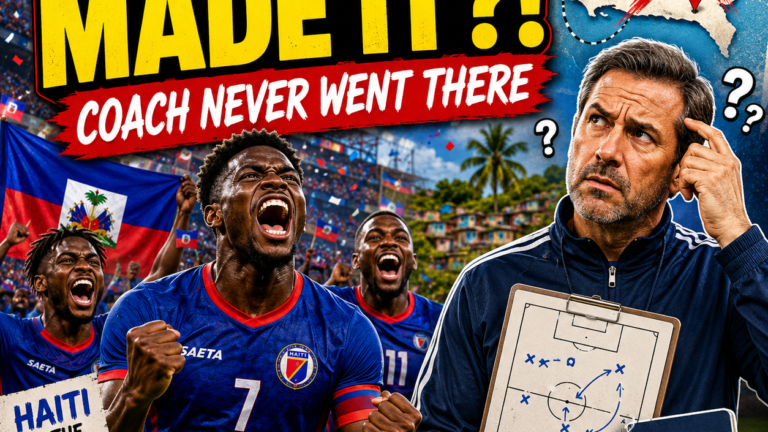
Picture this: you’re the head coach of a national football team. You’ve just guided them to the World Cup for the first time in 52 years. The whole country is dancing in the streets. And you have never, not once, visited that country.
That’s not a brain teaser. That’s the actual situation with Haiti at the World Cup 2026. Their French manager, Sébastien Migné, runs the team without ever landing on Haitian soil — because there are no international flights going in, and it’s too dangerous to try.
So how does a team like that not just survive qualifying, but win their group ahead of bigger, richer nations? Buckle up. This is the strangest, most heart-punching qualification story of the entire tournament.
First, the part that sounds completely made up
Haiti hasn’t played a single “home” game in years. Armed gangs control most of the capital, Port-au-Prince, and the country is in the middle of a brutal security crisis. So FIFA matches that should have been played in Haiti got shipped roughly 500 miles away to Curaçao instead.
Read that again. Their home matches were played in a different country.
And yet, in that borrowed stadium, Les Grenadiers (“the Grenadiers” — basically “the grenade-throwers,” which is an absurdly cool nickname) beat Nicaragua 2-0 in November 2025 to punch their ticket. They topped a qualifying group that featured supposed favorites Honduras and Costa Rica. Nobody saw it coming.
Okay, but who’s actually on this team?
Here’s the second plot twist: almost none of the players live in Haiti either.
Out of the entire World Cup squad, only one plays in the domestic league. Everyone else is part of the Haitian diaspora — kids of immigrants who grew up in France, England, the United States, Canada, and beyond, and chose to play for the country of their parents rather than the country on their passport.
It’s basically a global scavenger hunt for talent with Haitian roots:
- Johny Placide — the 38-year-old goalkeeper and captain. A career spent grinding in French football, and now, finally, a World Cup.
- Duckens Nazon — Haiti’s all-time leading scorer. He bagged six goals in qualifying, including a hat-trick against Costa Rica. Casual.
- Wilson Isidor — a quick, in-form striker at Sunderland who switched his international allegiance from France to Haiti. France’s loss.
- Jean-Ricner Bellegarde — a Premier League midfielder at Wolverhampton and the technical brain of the team.
- Frantzdy Pierrot — the target man up front who does the heavy lifting.
This isn’t a team being assembled out of pity. It’s a team being assembled out of belonging — a nation calling its scattered children home, even when “home” is a place half of them have barely seen.
They qualified on the most Haiti day imaginable
Now here’s the detail that gives you goosebumps.
Haiti clinched their spot on November 18 — the exact anniversary of the 1803 Battle of Vertières, the final fight that secured Haiti’s independence from France. That battle is why Haiti became the world’s first free Black republic in 1804, born from the only successful large-scale slave revolt in history.
So a country founded by people who literally fought their way out of chains, on the same calendar date, more than two centuries later, fought its way back onto the world’s biggest sporting stage. You could not script that. A Hollywood writer would get told it’s “too on the nose.”
The ghost of 1974 (and the goal that broke a world record)
Haiti’s only previous World Cup was 1974 in West Germany. They lost all three games and conceded 14 goals, so on paper it was a disaster.
But buried in that disaster is one of football’s greatest underdog moments. Striker Emmanuel Sanon scored against mighty Italy and, in doing so, ended legendary goalkeeper Dino Zoff’s world-record streak of 1,143 minutes without conceding. A tiny Caribbean nation broke a record held by one of the best keepers who ever lived.
That goal is still folklore in Haiti. The 2026 team isn’t just chasing a result — they’re chasing a ghost in red and blue.
So… did they get an easy draw? Absolutely not.
Football, of course, has a sense of humor. Haiti landed in Group C, which might be the toughest in the entire tournament:
- Brazil — five-time world champions, the most decorated team in history.
- Morocco — the African powerhouse that stunned everyone by reaching the semifinals in 2022.
- Scotland — back at the World Cup for the first time in 28 years and absolutely buzzing about it.
Haiti open against Scotland, then face Brazil, then close against Morocco. It’s the definition of a group of death. The realistic odds of advancing? Slim. Very slim.
The honest answer: probably not far, and that’s not the point
Here’s where most articles would feed you a “BELIEVE AND THEY’LL SHOCK THE WORLD” line. We’re not going to insult you like that.
Realistically, beating Brazil and getting out of that group would be one of the biggest upsets in World Cup history. It’s possible — football is chaos — but it’s not likely. Haiti’s coach plays a fast, physical, counter-attacking style that can trouble big teams on the right day, and a squad full of European-league players is far more dangerous than the 1974 version. But Brazil and Morocco are simply operating on another budget.
And honestly? Winning was never the whole story.
The point is that a country going through hell — gang violence, political collapse, no home stadium, a coach who can’t even visit — still found a way to put eleven players on the field at a World Cup. That’s not a sports story. That’s a survival story wearing football boots.
When Les Grenadiers walk out for that first whistle, an entire scattered nation will be watching from Port-au-Prince to Brooklyn to Montreal to Paris, all screaming the same thing: “Grenadye, alaso!” — Grenadiers, attack.
Whatever the scoreline says afterward, that moment already counts as a win.
What do you think?
Is Haiti the best underdog story of World Cup 2026, or does another team have them beat? And be honest — did you even know a national team could qualify without a coach setting foot in the country? Drop your hottest take in the comments. We read every single one (and we judge the bad ones silently).

Add comment