The linguistic paradox that will ruin your next dinner
You walk into a restaurant. You sit down. You wait.
Five minutes pass. Ten. Fifteen. Your stomach growls like a disgruntled Rottweiler. You glance around, trying to make eye contact with literally anyone holding a notepad.
And then it hits you — a thought so devastating, so cosmically unfair, that it shakes the very foundation of the English language:
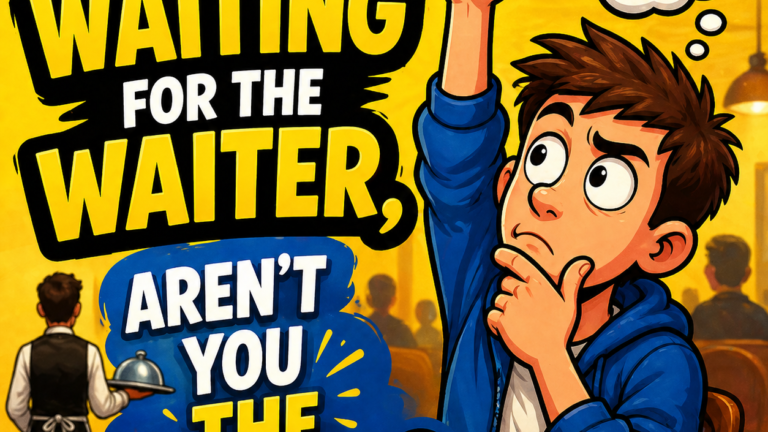
If you’re waiting for the waiter… aren’t YOU the one doing the waiting? Doesn’t that make YOU the waiter?
Welcome to the dumbest philosophical crisis you’ll have this week.
Let’s Break This Down (Unnecessarily)
The word “waiter” literally means “one who waits.” That’s it. That’s the whole job title. Not “one who brings food.” Not “one who remembers your drink order.” Not “one who judges you for ordering a second basket of bread.”
Just… one who waits.
But here’s the thing — the waiter isn’t waiting for anything. They’re walking. They’re carrying plates. They’re pretending they didn’t hear you say “excuse me” for the fourth time. They’re doing everything except waiting.
Meanwhile, YOU are sitting there. Doing nothing. Staring at a menu you’ve already memorized. Watching other tables get their food. Slowly losing your will to live.
You are the one waiting. You are the waiter.
The person with the apron? They’re the busier. The ignorer. The plate-carrier. But a waiter? Absolutely not.
A Brief History of This Linguistic Crime
The word “waiter” dates back to the 1660s. Back then, it actually made sense — servants would literally wait in the room, standing by until their employer needed something. They were professional standers. Elite loiterers. Championship-level do-nothings.
So the name was accurate. For about 300 years.
Then restaurants happened. Suddenly, these people were running around, taking orders, dodging toddlers, and balancing four plates on one arm like caffeinated circus performers. The job changed completely, but the name just… stayed.
It’s like if we still called pilots “horse riders” because that’s how people used to travel. Or if we called programmers “typewriter operators.” The label expired. Nobody updated it.
The Waiter vs. The Waited: A Comparison
Let’s be honest about who’s doing what in this relationship:
The “Waiter” (the employee): Running around. Taking orders. Carrying hot plates. Memorizing specials. Refilling drinks. Avoiding eye contact with Table 7 because they’re not ready yet.
You (the customer): Sitting. Waiting. Refreshing your patience. Wondering if they forgot about you. Googling “is it rude to wave at a waiter.” Considering just eating the decorative bread on the table.
One of these people is waiting. It’s not the one in the apron.
What Should We Actually Call Them?
If we’re being linguistically honest, here are some better job titles:
- Food Courier — because that’s what they do
- Order Rememberer — an underrated skill
- The Bringer — dramatic, but accurate
- Table Therapist — because they deal with your emotional needs too
- Professional Plate Balancer — respect the craft
- Sprint Specialist — have you seen them move during a dinner rush?
And what should we call the customer?
Easy: The Waiter.
Because that’s literally what you’re doing.
The Real Philosophical Crisis
This isn’t just a language problem. It’s an existential one.
Think about it. You go to a restaurant to be served. To be taken care of. To not cook for once in your miserable life. But the moment you sit down, you enter a state of pure, helpless waiting. You can’t cook your own food. You can’t grab your own drinks. You can’t even get up and walk to the kitchen without someone calling security.
You are, in every possible sense, at the mercy of the waiter who is not waiting.
You became the waiter. And the waiter became the one with all the power.
The entire restaurant experience is a lie built on an inverted job title. And nobody talks about it because we’re all too hungry to care.
Final Thought
Next time you’re sitting in a restaurant, stomach growling, watching your server walk past your table for the seventh time without making eye contact — just remember:
You are the waiter now.
You always were.
Enjoy your bread.




Add comment