
Here’s a question that sounds like a five-year-old asking it, but will make a grown adult quietly stare into the void: if the sky is blue, and the sky is literally just space we’re looking at from the bottom, why is space black?
Same sun. Same light. Same universe. One spot is a gorgeous Instagram-filter blue, and the spot right next to it is the color of your soul on a Monday.
What gives?
Spoiler: the answer isn’t that the sky is “made of blue.” The sky isn’t made of anything blue. The blue is a magic trick performed by air, and once you see how the trick works, you can’t unsee it.
First, let’s kill the obvious wrong answer
Most people assume the sky is blue because it’s reflecting the ocean. Adorable. Completely backwards. The ocean is mostly reflecting the sky. If the sky-reflects-ocean theory were true, deserts thousands of miles from any water would have beige skies, and they very much do not.
The other popular guess is that the air itself is just… blue, like a giant tinted window. Also wrong. Air is colorless. You’re looking through miles of it right now and reading this just fine.
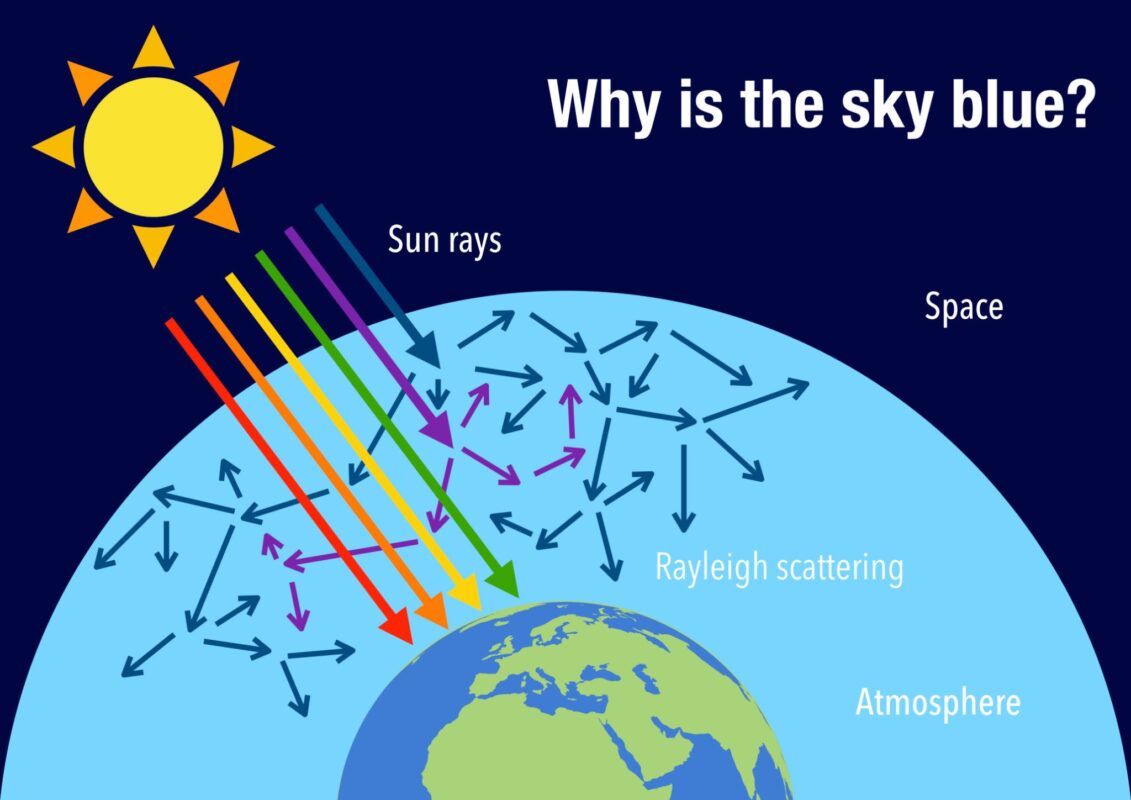
The real answer involves a phenomenon with the gloriously nerdy name of Rayleigh scattering.
Sunlight is secretly a rainbow in a trench coat
Here’s the thing nobody tells you: white sunlight isn’t white. It’s every color smooshed together, traveling as waves. Blue light has a shorter wavelength compared to red light — think tight, jittery little waves for blue, and long lazy rolling waves for red. Medium
Now send all those colors crashing into Earth’s atmosphere, which is packed with nitrogen and oxygen molecules. These molecules are tiny — way smaller than the light waves hitting them. And here’s the kicker: the strong wavelength dependence of Rayleigh scattering means that shorter blue wavelengths are scattered more strongly than longer red wavelengths. Wikipedia
How much more? Buckle up. Compared with red light, blue light is scattered about 9 times more efficiently. Nine times. The blue light gets violently pinballed in every direction across the entire sky, while red light mostly shrugs and keeps going straight. Substack
So when you look up at any random patch of sky that isn’t the sun, the light bouncing into your eyeballs from all directions is overwhelmingly blue. The sky is blue because the air is essentially a blue-light pinball machine.
(Fun side note: violet light actually scatters even more than blue. The sky “should” be purple. But the eye is more sensitive to blue light, which is why the sky appears blue rather than violet-tinted. So the color of the sky is partly a quirk of your own retinas. The universe is doing one thing; your eyes are reporting something slightly different. Cool. Normal. Nothing to worry about.) EBSCO
Now, the punchline: why space is black
Ready for the dumb-but-profound part?
To scatter light and make it blue, you need stuff to scatter it off of. Air. Molecules. Tiny things for light to bounce around in.
Space has none of that. Space is a vacuum — basically nothing, stretched out forever. Light from the sun travels through it in a perfectly straight line and never gets scattered, because there’s nothing there to do the scattering. No air, no pinball machine, no blue.
So out in space, sunlight just goes wherever it’s pointed. Look toward the sun? Blinding. Look anywhere else? Black, because there’s no light coming from that direction — nothing redirected it toward your eyes.
That’s why astronauts on the Moon see a black sky in broad daylight, standing in full, brutal sunshine. No atmosphere = no scattering = no blue. The sun is roasting them while the “sky” looks like midnight.
And you can actually watch this transition happen yourself. At high altitudes — climbing mountains or flying in a jet — the sky above looks darker than usual, because there’s less air above to scatter the light. Climb high enough and the rich blue starts fading toward the black of space. The blue isn’t disappearing. You’re just running out of air to make it with. Substack
The one-sentence version
The sky is blue because Earth wears an atmosphere that scatters blue light all over the place, and space is black because space is empty and has nothing to scatter anything.
The blue sky isn’t a thing. It’s a side effect — a glitch of physics that happens to be beautiful. You’re not looking at a blue ceiling. You’re looking at sunlight getting body-slammed by air molecules, and your eye is collecting the wreckage.
Which is honestly the most poetic way to find out that the prettiest thing you see every single day is just light bouncing off invisible gas. Don’t think about that too hard before bed.
Bonus brain-melt for the road: the same exact effect is why sunsets are red. During sunrise and sunset, sunlight passes through more atmosphere, scattering away the shorter wavelengths and allowing longer wavelengths — reds and oranges — to dominate. The blue gets scattered out before it reaches you, leaving the leftovers. Sunsets are basically the sky’s blue light running out of road. 🌅



Add comment